- How might you describe Zhang Yimou’s visual style or aesthetic?
“But as with past Zhang Yimou efforts, the true stars are the sets, costumes, and scenery, a breathtaking banquet of colors and textures filmed with rapturous affection by cinematographer Xiaoding Zhao.”
Beautiful and magnificent mise en scene, often with great magnitude through the use of the outdoors.
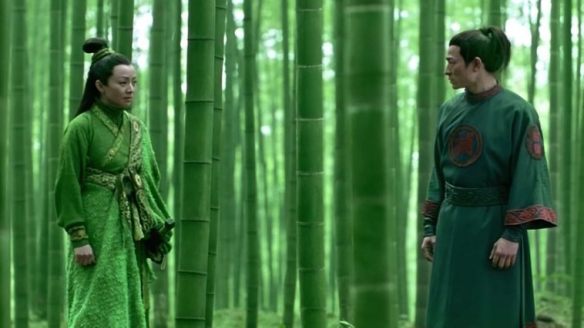
““These man-made marvels can hardly compete, however, with the landscape through which Mei and Jin make their long escape. The autumn foliage of the woods bursts with colors so vivid they could shame American trees into staying green all year long; the bamboo grove where Mei and Jin are ambushed (shot on location, not in a studio) is an otherwordly setting, a shaded yet open arena punctuated by bare tree poles.””
- What is significant about Zhang as a Chinese filmmaker, the themes of House of Flying Daggers and its production context (contemporary Chinese Film Industry)
He avoided censorship by exploring themes and political ideologies in a time and place set in the past. This allowed him to explore what he wanted to explore, while still having the film shown.
Rebels stand in for the communists? But it’s not hammered in.
- What common criticisms are there of the film? What are seen as it’s strengths?
“It nonetheless soars as an action adventure… the movie blurs the line between dance and combat. It’s a correlation made explicit early in the film. After performing a slow, traditional dance for Jin at the Peony Pavilion, Mei is challenged by Leo to play the “echo game.” Upright drums are assembled in a circle around the blind girl; when Leo flicks a bean off one of them (then two, then dozens), Mei follows his lead with the long, weighted sleeves of her dress, spinning, kicking, and leaping with acrobatic zeal. (It undoubtedly helps that star Zhang Ziyi trained as a dancer before entering film.) At the end of her performance, the shift from art to violence is completed when Mei sends out one sinuous sleeve to unsheathe Leo’s sword and attack him with.”
“As in Hero, Zhang Yimou finds a balance between computer-generated effect and live-action stunt that continues to elude most Hollywood filmmakers. The soldiers’ javelins and rebels’ boomerang-like daggers may be digitized, but the combatants themselves are not. Even Mei’s remarkable sleeve-wielded sword is made possible with wires rather than pixels. As a result, no matter how delightfully cartoonish the action may at times become, it never looks like a cartoon.”
“I enjoyed “House of Flying Daggers” a lot, but I think “Hero” is a far superior film in many respects. First, the visual style: Cinematographer Zhang Xiaoding worked masterfully on “House of Flying Daggers,” and the end result is impressive. However, it was Christopher Doyle who worked on “Hero,” and his precision and attention to details are difficult to surpass. Each scene in “Hero” supports the plot and the philosophy underlying those scenes. Second, “House of Flying Daggers” does not carry the deep historical commentary that I discussed in the review of “Hero”. As I stated previously, it is primarily a love story using history as a backdrop. Nevertheless, “House of Flying Daggers” is a highly enjoyable film and a real visual artwork of cinema.”
Significant amount of melodrama. For a Western audience it may appear bombastic in its form.
- How are men and women represented in the film?
““Although they were renowned for their polite behavior, the courtesans were known to dominate conversation with elite men. The ladies were not afraid to openly castigate or criticize prominent male guests who talked too much or too loudly, boasted too much of their accomplishments, or whose rude behavior had in some way ruined dinner for everyone (on one occasion a courtesan even beat up a drunken man who had insulted her). (…) Men enjoyed the presence of assertive, active women” source Wikipedia …This validates “House of Flying Daggers” as an accurate historic re-imagination of the attitudes of the time.”
Men are shown as superior at the beginning of the film, which links into context of the time e.g. men being in the army not women. ??
- love triangle … wuxia genre set in a specific political/historical context. What is peculiar about how this plot and setting is explored in the film?
“history is only a setting for “House of Flying Daggers”. Though it is a Tang period inspired love story where: “individuals often share the plot designs of quick passion, inescapable societal pressure leading to the abandonment of romance, followed by a period of melancholy.” (Source: Wikipedia) In other words, lovers had to face the choice between passion and duty, which created even more tension. “
Set in the past is not unusual.
Love triangle may be weird in a film like this, and love triangles are cliche?
- How accurate are the depictions of life in the Tang Dynasty? Why might we question the authenticity of these representations? Provide examples and evaluate.
“The Tang dynasty is often considered a “golden age” of Chinese civilization during which all areas of culture and civilization flourished – literature and poetry (famous poets Li Bai and Du Fu are from Tang period), painting, commerce, as well as science and innovation. Bordellos of the time were places of beauty and artistic expression, just as the one depicted in the film. The head mistresses of bordellos had wealth and power. Courtesans were intelligent, artful singers and poets who entertained guests with their skills and conversation.” Although the brothel can be considered over the top and stylised, it does have an element of truth. The Tang Dynasty period was full of peace, literature and poetry. Bordellos of the time were places of beauty and artistic expression, just like the one depicted in the film.
- Why might the depiction of a heroic rebellion against the Tang Dynasty be a surprising production from one of China’s largest film producers?
He avoided censorship by exploring political and social ideologies in a different context, by setting the film in the past.
- How might domestic, East Asian and audiences from around the world respond differently to ‘House of Flying Daggers’?
‘Hero’ is also used in the comparison, but it was not widely shown. Some people believed Hero was better in terms of exploring historical context. The director has said that Hero was the experiment and House of Flying Daggers was the real thing.
Western audiences used to a different style.
Actress from Crouching Tiger Hidden Dragon which did very will in the box office and every where.

 I used this website:

 Georgia Newman Film Studies