
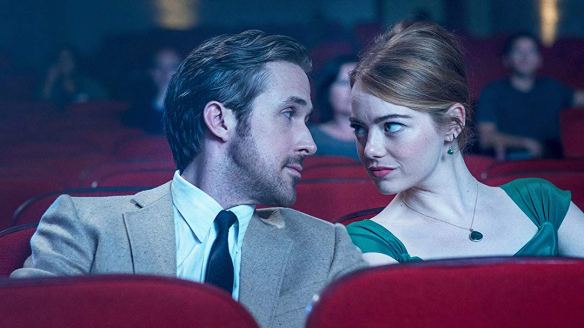
New York Times article 15.02.17
- Some people didn’t like the movie because they felt as though it wasn’t a true musical, or at least not a good enough one, and compared the movie to musicals such as ‘Hamilton’. Saying that, “A musical can be more than just a meet-cute song-and-dance escape; it can also be an opportunity to push the form forward.”.
- One of the main reasons for debate seems to be its Oscar nomination, and people claim that it is worse than other nominations, and films that weren’t even nominated, and are sad at the prospect that it had a high chance of winning, “There are better movies nominated for best picture than “La La Land.” (There are also better movies not nominated.)”. They also believe that one of the main reason why it had a high chance of winning was purely because it provided escapism for the audience, unlike the majority of the other films that explicitly explores society, “Look at the other films up for the award. They are, for the most part, hard-edged realist stories that take an unflinching look at life. “La La Land” allows an escape, a dream, a fantasy, giving us a brief flight from this maddening world.”. Another quote that supports this opinion is this, “La La Land” is a visual poem and a timely escape from all the tension and traffic and division in our lives. You don’t have to think much; you just watch it. The stars are lovely. The songs are catchy. And the camera lifts you right out of your seat to take you along for the ride.”
- Some people liked it because it subverted the form and plot that they thought it would take, such as the ending, “But one reason I ultimately liked the film is its unexpected ending: “La La Land” gently subverts the very tradition it seemed set to embrace.”
- Some loved the themes such as jazz and nostalgia, but were upset with the casting, and felt the cast should have been better suited for musicals in the sense that they should have better singing and dancing skills, “There I was, rooting for nostalgia and fidelity to win the day, hoping Sebastian would not sell out by playing crowd-pleasing fusion instead of the jazz he loves. But I was doing so while watching a once-in-a-blue-moon Hollywood musical that opted to play it safe and cast a pair of charismatic, movie stars rather than bona fide triple threats who could truly sing and dance as well as act. It was a fusion musical.”.
- Some feel it can be good but struggles to withhold the musical genre, “The trouble is the earthbound, almost place-holder quality of the music and choreography: good ideas in the right places that lack the poetry, inspiration, rhythm or just pizazz to lift the movie to another plane of fantasy. The movie improves when it eases off its struggle to be a musical — until the end, when it uses the movie musical’s access to fantasy to deliver an emotional wallop.”
- Some people believe that the film forces the spectator to be passive
- Monica Castillo said, “The vibrant and diverse community I knew when I lived in Los Angeles largely disappears after the first dance number and a few scenes in jazz clubs”
New Yorker article 12.12.16
In what ways is La la Land derivative but also original?
- “Not an adaptation of a Broadway show, or a coda to “Glee,” with a jukebox of preëxisting tunes, but an original creation, with music by Justin Hurwitz and lyrics, for five of the six big numbers, by Benj Pasek and Justin Paul. To call the film “original,” however, is to raise a bunch of questions, since part of its purpose is to summon up remembrance of things past.”
- “We kick off in Los Angeles, on a freeway, though freedom is in short supply. Cars and trucks are snarled up, going nowhere, and you’re expecting tempers to snap. That’s what happened to Michael Douglas, in the same fix, in the same city, in “Falling Down” (1993),”
What is positive but also questionable about the film’s opening and enduring image of Los Angeles?
- “We kick off in Los Angeles, on a freeway, though freedom is in short supply. Cars and trucks are snarled up, going nowhere, and you’re expecting tempers to snap… But Chazelle’s folk don’t run riot with guns and baseball bats. Instead, they rampage into dance, climbing onto the hoods and the roofs of their vehicles, making holiday in the heat, and chanting, “Another Day of Sun.” The camera swings and curvets in accord, then rises to survey the scene—half a mile of merriment where none should be.”
- “This spectacle gets a lot done. First, it serves notice that song, as much as chatter, will be the means of expression.”
- “The sequence revives the old-fashioned view of L.A. as a breeding ground of reverie and hope”
What is thematically significant about Mia and Seb’s career ambitions?
- “Notice how the hero and the heroine of the movie, in line with its title, subsist on fantasies instead of careers, conforming to a chase-your-dream credo that is not so much traditional as antique.”
- Seb represents the past, and Mia the future
What is peculiar about Chazelle’s ‘nostalgia’, as presented in ‘La la Land’?
- It’s not just a theme, it helps to drive the film, “He knows what people think about jazz: “They always say, ‘Let it die.’ Not on my watch,” he announces, like Ed Harris refusing to abandon the astronauts in “Apollo 13.” This idea—that nostalgia can be gutsy and purposeful rather than moony and limp—is what powers “La La Land” and inspires Sebastian to invite Mia to a screening of “Rebel Without a Cause,” at the Rialto, in South Pasadena.”
- Sebastian s stuck in the past, but Mia is looking towards her future.
What effect on the spectator is achieved by shooting the film on Technicolor film?
- “The cinematographer, Linus Sandgren, shot it on film, and the colors, rather than merge into the landscape, seem to burst in your face. Mia and her roommates, on a night out, sashay down the street in dresses of red, yellow, green, and blue—hot primary hues to match the mood…At the opposite end of the spectrum, as Mia and Sebastian dawdle and dance beside a bench, high above the city, the light glows violet and rose—a soft spell conjured by the magic hour.”
What criticisms might be made of the singing and dancing? Why might these criticisms be missing the point?
- “If the choreography, performed with more zest than unworldly expertise, lacks the chill of the nonpareil, that’s the point. It’s no surprise that Emma Stone, whose manner is grounded in pathos and comedy alike, should carry the film with ease. She has a long solo (“Here’s to the hearts that ache, / Here’s to the mess we make”), and the husky catch in her breath, which would have had Minnelli and his masters at M-G-M calling for the overdub, is precisely what lends the melody its kick—the striving in Mia’s unmighty voice is a measure of her desires.”
The article seems critical of the narrative structure. Why? Do you agree? Why/not?
- “That may be why, in the second half, the tale runs a little out of puff. Though the plans of the characters come to fruition, there remains a wistful sense of roads not taken, and the final act of the drama, set five years later, is both climactic and indecisive, swaying back and forth between the imagined and the real, unwilling to give up the chase.”
- I think some people were unhappy with the five year jump and would have rather it just carried on from where it left off, and that it didn’t feel right during such a time in Mia and Sebastian’s relationship for there to be a massive time skip that beings everything to a conclusion. This person also seems to be unhappy that they did a ‘what could have been’ sequence’, but I personally liked this and the ending and the structure and saw nothing wrong with it. If anything, it just made it more emotional as everything was such as shock and such a whirlwind.
Why might Lane want to encourage seeing the film at a good quality cinema?
- “Catch the film on the largest screen you can find, with a sound system to match, even if that means journeying all day.” – probably for the good sound quality and also to see all of the colours beautifully.
New Statesman 6th February 2017
The film explores the value of the relationship between making art and spectating art. Mia and Sebastian are mainly seen spectating art, such as when they go to the jazz club or when they go to and see ‘Rebel Without a Cause’. Plus, at the beginning of the movie, Sebastian is seen literally rewinding old music over and over, and then just copying it on the piano, this performance not only shows the importance of spectating art, but it also shows how Sebastian represents the past, contrasting to Mia who is learning new lines; together they help to create the binary opposition of the old and new, and the past and future. They even “fall in love as observers – their romance blossoms as they share experiences as audience members.” Such as when they walk through the Warner Bros. set or go and watch ‘Rebel Without A Cause’. Plus, at the end of the movie, they even become spectators of their own lives as they observe a film about themselves. There are however “Criticisms of the focus being on Seb performing also rest on the idea that making art is fundamentally more important than engaging with it” however Mia suggests the opposite. Spectating to her is important and requires a lot of attention and knowledge. For example, at dinner with Greg, Mia notices the jazz music. Plus, it’s spectating that gave her the drive to create her own art, such as how she used to watch movies with her aunt. But obviously creating art is also represented as important, as both the main characters’ ambition is to do so. Mia wishes to be an actress, and writes her own one woman play, and Sebastian wants to own and play in his own Jazz club. The film plays also with spectatorship in terms of spectating art. Just before Mia meets Sebastian, she walks past a mural of many famous people such as Marilyn Monroe. The mise en scene of all these famous people sitting in cinema seats, as though they were the audience and not the ones in the art, inverts the roles of artists and the audience and makes Mia, the passer-by, the one in the art, this too emphasises the importance of creating art. The cinematography and mise en scene also emphasises the importance of creating art. Such as, when Mia is auditioning at the end of the movie and is told to tell them any story that she would like. The lighting is used to single her out, and the mise en scene becomes us just seeing Mia, we are just positioned with Mia alone because her creating art is important and transports her to a different place where creating art is all she knows and wants. The camera then circles her, emphasising the importance of creating art which she is doing in that moment.
The film also explores the theme of art in a way that presents it as impactful on people’s lives. One way that this is done, is how “the script also plays with the idea that watching movies can be a kind of emotional research, not just for an actress preparing for a new role, but for anybody. For Seb and Mia, their “research” brings them to each other”. The art impacted their lives greatly, observing art like ‘Rebel Without A Cause’ and the Jazz band brought them closer together. We even seen their relationship “play out as a series of performances”. It starts with them first meeting, when Sebastian is playing the piano at the restaurant. Then, Mia requests for Sebastian to play “I Ran” at a party, Sebastian then performs with his new band and then in Sebastian’s own club. “Each of these scenes reveal incremental changes in Mia’s perspective on her life, her ambitions, and her desires, as she moves from awe to playful cynicism to optimism to disillusionment and, finally, to a bittersweet compromise of all the above.”
There have been feminist critiques of ‘La La Land’. One way that the film is criticised is that Sebastian is presented as the performer, while Mia is presented as the observer, which could be interpreted as dismissing women as “primarily muses or facilitators of male art and ambition.” However, we tend to see Sebastian perform through Mia’s eyes, and during this positioning the audience gets to see her emotional response, and her emotional development. Plus, we frequently see Mia creating without Sebastian even being present. Such as, when she writes her own play, when she is auditioning and even when she is performing. The fact that Mia tends to watch Sebastian perform and not the other way around could link into the binary opposition of the past and the future, and how they cannot possibly co-exist. Mia (the future) watches the past and is inspired by it, but Sebastian (the past) doesn’t make her play, the past doesn’t match up with the future. Mia is presented as someone who is always exploring art, and how this helps her to create her own. She’s open to films she’s never seen, and listening to music she doesn’t normally listen to despite saying, “I hate Jazz”. This helps to inspire her, and her art, such as, “Her time spent watching films with her aunt inspires the audition that bags her breakout role”. Plus, we see her emotionally develop through Sebastian’s performances, “We rarely see him perform if not through her gaze, and we see her emotionally develop through her evolving reactions to his music, while the film’s most fantastical scenes are all her projections, her imaginative response to what she hears.” Mia represents the future and change, contrasting to Sebastian. Their relationship is one way that the film shows the “conflict” and “compromise” that is needed when making art, as the balance between old and new cannot be equally split, they cannot properly co-exist. “Seb, on the other hand, is a closed book to the new. He’s never genuinely interested in The Messengers, and prefers to stay stuck in the past, listening obsessively to the same pieces of music over and over again.” Sebastian wants jazz to stay the same, he contrasts greatly to the lead of the Messengers who wants to re-invent jazz in order to please a larger group of people. Sebastian represents the old, and the past.
“The visual landscape of La La Land creates a world hovering somewhere between fantasy and reality. Through melodic camera movements, oversaturated colour palettes, dreamlike fabrics, dance and song and references to Old Hollywood’s most iconic scenes, the ordinary becomes fantastical. Bathroom lamps become spotlights; hilltop sunsets become perfect movie sets.” It can all be interpreted that this fantasy element was used to show the way that art can transport you. “And it works both ways: a cinematic tracking shot of Mia auditioning, slowly focusing on the emotion of her face, is interrupted when an assistant outside the door enters the right of the frame. Many of the film’s most dramatic moments are punctured by the mundane: phones ring, smoke alarms go off, records abruptly finish, analogue film eats itself just before the romantic climax. These both serve to disrupt and reinforce classic tropes”. The scene where Mia is interrupted by someone wanting to get lunch, just emphasises how engrossed Mia gets in her art/auditioning, as the person behind the door window being blurs shows us the spectator that Mia is not aware of her surroundings but rather heavily involved with her art. The audition scene at the end of the movie also shows how much Mia is engaged in her art, through the spotlight that singles her out and the camera that circles her.
 Georgia Newman Film Studies