Week 25 ISP – Essays on Everything
Reply

The Fallen Angels Question didn’t work for some reason, so here it is:
Section D: Film movements – Experimental film (1960-2000)
62) To what extent is the film you have studied recognisable as the product of an auteur? [20]
Fallen Angels is very recognisable as the product of the auteur Wong Kar-wai. For example, his recognisable use of film form. One of the main examples is his use of non-diegetic pop songs throughout the movie, not for ironic purposes, but to connote certain feelings to the audience. Another main example is his use of rain, which he uses to bring characters together in Fallen Angels, furthering the themes of loneliness and togetherness. The mise-en-scene of rain is also used in his other films like ‘The Grandmaster’. Furthermore, he has a specific use of editing in terms of time manipulation to convey meaning. Such as, the use of step printing, like during the assassination sequence, which to partially used to connote a sense of coolness to the character. He also uses slow motion, like the slow motion of the train dirivng past during the opening, which has a sense of lonliness. Simialrly, his use of cinematography also does this. His use of wide angle lens and deep depth of field shots create the sense of sepeartion, as the character at the front is distant from those behind them, creating the sense of lonliness and need for connection with other human beings. These themes can also be seen in his film ‘Chungking Express’, which is the sister film to Fallen Angels, which was initially the third part to the movie. Another connection between these movies are the actors. Interestingly, the same non-actor was used in both, which is an experminetal attitude to film making.
Narratively, Wong Kar-wai’s work tends to be experimental, which is part of his auteur signature. Such as, instead of the narrative focusing on plot and explantaion, it focuses on character, themes like lonliness and connection, and emtions, as he uses expermintal narrative devices and narrative structure to convey very real human emotion. Such as, the narrative device during the opening of narrative repeition of two characters following the same path through the station, then both picking up the same key (close up) and enetring the same house but at different times highlights their lonliness and lack of close connection. This is instead of narrative devices being used for expostion, which most films have during the opengn equilibrium, but Fallen Angels does not. Throughout, instead of explaining who the charcaters are, and why they do what they do, like why the man assisinates people, Wong Kar-wai doesn’t tell us, and instead focuses on the emotion. This could be why the ending equilibrium is open instead of a closed ending, as the two characters on the same bike, with her holding on to him, is suggesting a closness between the two, even if momentary, which in a way sums up the themes of the films and the emotions of the film rather than any plot. During this ending, the lighting in the tunnel is green, and green lighting was also iused earlier when the son was spying on his dad watching the footage he filmed. As Wong Kar-wai doesn’t foolow traditional colour theory, it can be hard to intepret the exact connotations and meaning of his colour choices, but they are picked intentionaly and for emotional meaning. It’s possible due to both times that green lighting was used that it represents closeness between the characters.
Ideology:
An ideological analysis of the feminism ideology has been important in developing and understanding the theme of independence in La La Land. For example, during the messengers sequence, Emma Stone’s performance highlights her strong reaction to the situation. When she hears the Messenger’s music, it’s clear that she understands that Seb is performing music he doesn’t like and is living a dream that isn’t his. This is evident on her face which we see through mid-shots focused on her, and the use of change in coloured lighting from orange to blue suggests a lack of passion once she hears the song representing how Seb has a lack of passion for this band which an active spectator would pick up on whereas a passive spectator would just pick up on his performance of playing with one hand in his pocket. Mia feels strongly about this, and quickly tells Sebastian that she believes he’s not where he wants to be or should be. This reaction shows that she doesn’t spectate passively, which goes against the feminist critique that Mia is portrayed as a spectator and she only spectates passively. This is also proven wrong earlier in the film when she picks up on the jazz music in the restaurant and has a strong reaction to it and therefore leaves. Her having her own opinion and strong reaction to art and Seb’s performances shows that she is independent, therefore linking onto the theme of independence, and by doing this the film explores feminism in a way that proves the feminist critique wrong as Mia is a self-reliant and independent woman. The theme of independence is started during the opening, when the woman is singing about leaving her old life and close ones behind to achieve her dreams which is reflective of Mia later on in the film. However, this does link into the representation of LA because the woman in singing a song in major key in a yellow dress (which has happy connotations) yet they’re in a traffic jam which could be a visual metaphor for how it’s actually hard to make it in LA. Moreover, Mia is represented to spectators as an independent and passionate performer, such as during the audition scene. The spotlight motif that is reminiscent of Seb’s spotlight is used to focus in on her, conveying to active viewers that she is lost in her art and passionate, therefore emphasising her independence as a performer and as a woman as well as he ability to perform brilliantly just like Seb.
Another ideology that is explored is traditionalism which links in with the binary opposition of traditionalism and progression. This binary opposition and theme are largely explored through Mia and Sebastian; she represents the future and he the past. For example, when we first meet them, Sebastian is rewinding tapes to old music and Mia is learning new lines. An passive or active viewer would consider how this is why during the messengers scene it’s made so clear that Sebastian is not where he should be. The spotlight that shines on him at the start is reminiscent of the spotlight from the restaurant, but after all the music kicks in it disappears and ‘in you face’ bright lights flood the screen. This reflects how Sebastian is no longer lost in his art because this isn’t the art he wants to perform, before he was sticking to traditional music and now, he’s performing modern music. Passive viewers are aligned with Mia because she isn’t happy with it either, and there’s more film form elements that tell the spectator to be unhappy with it too like the ridiculous dancers or the painful to listen to diegetic synth. This links to the ideology of traditionalism because the messenegers music is all about progression which contrasts against Seb’s tradionalists beliefs. Some people have pegged this moment with a feminist critique saying that Mia is always the spectator and Seb the performer. In many ways this can be proved wrong, but one way is to link it to the ideology of traditionalism and the binary opposition of traditionalism and progression. If Mia represents progression, it’s normal for future art to take influence from the traditional art, whereas, traditional art is less likely/never going to do so. Therefore, it’s not about gender, but rather the binary opposition of progression and traditionalism, which therefore links into the ideology of traditionalism.
Passive and Active Spectatorship:
The opening of ‘La La Land’ can been viewed on a passive level to seem absurdly happy with the upbeat diegetic music, the bright colours, and synchronised dancing. However, an active spectator would see beyond this appearance, and find the true meaning of the scene. The somewhat perfect aspects of the scene contrast the harsh reality of making it in Hollywood, therefore being a representation of LA and what it’s really like. For example, the scene is edited to appear as though it’s taken in one shot, which would seem perfect and dreamlike. However, the cuts are actually hidden in whip pans suggesting that everything is not as perfect as it all seems on the surface. Plus, as they all sing on the runway, the traffic jam can be interpreted by an active spectator to be a visual metaphor for what it’s like trying to make it in LA, it’s difficult and there’s not enough space for everyone. Moreover, the diegetic song may sound upbeat and happy, but the lyrics all suggest a more negative side to the situation including what they’ve given up on to try and make it. Meanwhile, there is a synchronised dance number (an element of the musical genre) again suggesting perfection which contrasts to the reality which they express in their song. In terms of responses, I think the preferred reading of this scene is to understand the true nature of making it in LA, and to consider the upbeat music, perfect looking cinematography and the use of bight primary colours as somewhat ironic. However, the primary colours do also give to the scene in other ways because of their connotations. For example, the use of red showing passion like the woman’s dress.
However, the opening scene of ‘La La Land’ also has passive spectatorship in terms of the film exploring the old and new, specifically old and new film. The opening shot is in black and white which is reminiscent of classical Hollywood, it then becomes colourful being suggestive of the modern film industry. There’s also an accidental Marilyn Monroe reference, which they decided to keep in because of said reference, where a woman’s dress blows up like Marilyn Monroe’s did in the film ‘The Seven Year Itch’, which is one of the most iconic bits of cinema ever and so using this moment was a perfect way for the film to continue exploring the binary opposition of the old and new, as well as traditionalism and progress. An active spectatorship may be required to explore the ideas presented regarding these binary oppositions and consider how the film is exploring the conflict and compromise in creating new art in terms of the old and the new. For example, the Cinemascape writing cannot be fully seen until the twin wipe and in the process it becomes more colourful, this editing and mise en scene is suggestive of the old new being co-existent, but also how there’s conflict as they can’t both exists at the same time without compromise. However, the theme of individuality suggests the importance of individuality in creating art and it not just being about traditionalism and/or progress. The different genres of diegetic music, and the performances of different dancing shows this individuality between them, and how it’s important, as well as being a good representation of LA.
The preferred response to the Messengers scene is to understand how although Sebastian is playing for a big and appreciative crowd, it’s not his dream. A passive spectatorship can see this in Mia’s performance, and as a spectator would align with her. Her shocked face paired with the harsh blue lighting with connotations of coldness rather than the original yellow lighting, all suggest that she is empathetic but also disappointed that Sebastian is dedicating so much time to a career that isn’t his passion. Sebastian’s performance can also be interpreted by a passive spectator that he isn’t where her wants to be or should be. Whereas in the restaurant he played passionately now he plays with one hand in his pocket. It makes sense to refer to the restaurant scene, as the opening of the Messengers performance has Sebastian under spotlight which is reminiscent of the moment on the restaurant where it identified how engrossed he was in his art. Now, the screen is flooded with bright and colourful in your face lights, a visual representation that this isn’t his dream, and he notices how Mia is lost in the crowd. Passive spectators can also pick up on this due to the commercial and over the top performance such as the ridiculous dancers, the very colourful and bright lights, and the synth. The synths diegetic noise is painful to listen to, again suggesting that this isn’t a good place to be especially for Sebastian.
However, the Messenger’s scene requires an active watch from the spectator as well in terms of the representation of women. The film has been criticised for Mia being displayed as the spectator and Sebastian as the performer. A passive spectator may feel this way, but an active viewer would feel differently and get the preferred reading rather than the oppositional. Not only does Mia perform plenty, but she never passively spectates art. She notices the jazz music in the restaurant which requires attentiveness and knowledge, and in this scene her emotions are clear. Mia doesn’t clap along like the rest of the crowd she is independent and has her own opinion which she is quick to tell Sebastian without hesitation. Plus, when Sebastian doesn’t keep the relationship equally balanced by coming to her play, she ends the relationship. Furthermore, Mia represents progress and the new in the binary opposition of the old and new (traditionalism and progress), as she creates new art like her one woman show and Sebastian represents the traditionalism/old, he rewinds his tapes and wants to stick with classic jazz. This could be why Mia is seen watching him more than he’s seen spectating her because progress tends to be inspired by the old while keeping individual, whereas the old is just individual, this is an active viewing of the scene and probably the preferred reading or maybe a compromised reading of the scene/binary oppositions that run through the film.
One way that Beasts of the Southern Wild and La La Land share a similar treatment of film form elements is through the fact that they both utilise a film form technique as a motif. For example, in BOTSW, there is the motif of the mise en scene of the aurochs. For example, when we see them before the hospital sequence. This element of mise en scene requires an active spectator as the spectator has to question what they represent. One response is that they represent Hushpuppy’s childhood, while another would be that they represent the environmental problems therefore linking on to the ideology of environmentalism as they came from the melting ice. La La Land also uses a film form element as a motif, but instead it uses cinematography. La La Land uses the spotlight as a motif to represent its messages about art and other ideologies. For example, when Mia first hears Sebastian play in the restaurant, the spotlight singles him out emphasising how he is lost in his art, his passion and showing his passion through his performance. This contrasts to later on in the film during the Messenger’s sequence, originally Sebastian has the spotlight on him, but it soon disappears as the screen gets flooded with bright coloured lights. An active spectator could respond to this by considering how the lack of the spotlight is another way that the film is showing us that this isn’t where Sebastian should be, he has no passion for this. Another way that the film shows this is through Mia’s performance. After she hears the music, we get a mid-shot of her displaying her strong negative reaction to the music. One response to a passive spectator could be that she is disappointed. She’s aware that it isn’t Sebastian’s dream, and that his heart won’t be in it. This strong reaction goes against the feminist critiques that criticise the film by saying Mia is represented as the passive spectator, as she clearly isn’t passively watching. Mia also gets the spotlight during her audition, which not only contrasts to the montage of her previous auditions, but it again shows her passion for her art and how she’s lost in it.
Both films use film form elements to get across binary oppositions to the spectator. One example of this is the binary opposition of the Levee and the Bathtub in BOTSW. For example, we are often positioned with the Bathtub rather than the Levee, even when the shot is a extreme long shot of the Levee it is at a distant and lacking colour suggesting our separation from it, as well as contrasting to the colourful Bathtub which we are aligned with. This links in with the films exploration of environmentalism as Hushpuppy’s voice over calls the factories ‘ugly’ and the Levee’s lifestyle contrasts greatly to the environmentally friendly lifestyle of the Bathtub as shown through the opening montage meaning we as spectators are aligned with the Bathtub. We are also inclined to be aligned with the Bathtub and not the Levee when the people come and take them to the hospital. Their mise en scene of the clean shirts makes them seem like outsiders, and the foley helicopter sound makes it feel like an invasion. Interestingly, not only are we aligned with the Bathtub we’re also inclined to compare our lives to there’s mainly through the opening montage which shows their strong community of them all being together, but also the negatives such as the racing babies. A preferred response is probably the negotiated response which acknowledges the good and the bad. Film form is also used to get across a binary opposition in La La Land but in different ways. La La Land explores the binary opposition of traditionalism vs progress. This binary opposition links into the themes of compromise and conflict, there is conflict and compromise between traditionalism and progress. Mia represents progress, when we first see her, she is learning new lines and she’s always willing to get influenced by new things like her newfound love of Jazz. Sebastian represents the past, when we first see him, he is seen rewinding his tapes of his old music; he’s stuck in the past. An active spectator could argue that this is a reason why they didn’t end up together, if they represent these two things, they can’t both exist fully together, there will always be conflict and compromise and one of them will have to exist over the other. This is shown through the film form in the fantasy sequence at the end of the film, with all the references to old and newer movies like when Mia gets handed the red balloon it’s almost as if it’s saying how nice it would be if we could have both traditionalism and progress and not have to pick, but in reality it’s not possible and so they separate. This scene can also be seen from the perspective of the romance genre which the film form also gets across, the fantasy sequence was a ridiculously happy Hollywood ending that couldn’t actually happen, only in movies, which they literally sit down and watch. In reality, it ends on a smile.
Both films use non-diegetic and diegetic sound to get across meaning. For example, in BOTSW, the ending uses music to convey messages. Before Hushpuppy turns around to face the aurochs there is powerful and building up non-diegetic music and when she turns around it transitions into the non-diegetic music box music which is representative of her childhood. This paired with the dialogue of ‘I gotta take care of mine’ could be interpreted as an active spectator of being representative of Hushpuppy saying goodbye to her childhood, as well as her standing up to her fears as the aurochs can be interpreted as a metaphor for her fears and troubles. This scene brings the coming of age element of the film to a close as it’s a signal that she’s grown up now, she’s ready to face her fears and take care of people. La La Land also uses sound to convey meaning such as during the dinner scene. The diegetic music of the upbeat version of ‘City of Stars’ has connotations of romance and happiness, which contrasts to their eventual raised voices and arguing. When the music suddenly ends leaving uncomfortable silence, a passive or active spectator could feel this is representative of the end of their relationship. The diegetic fire alarm also suggests this, as it suggests their relationship is no longer nice. This is supported by the use of colour, the yellow from the candle lights starts as nice and intimate but it’s meaning changes to frustration as the scene plays out. BOTSW also uses lighting, such as the fairy lights during the flashback sequence which allows the spectators to see the place from a child’s perspective which is why the ‘floating catfish shack’ appears loving and sweet.
Both films use film form elements to get across the theme of independence. For example in the BOTSW ending there’s the diegetic dialogue of ‘I gotta take care of mine’ said by Hushpuppy which suggests that she is independent and will help to look after her friends and family. The opening also suggests her independence through mise en scene as she lives in a separate house to her father. Some spectators might have a surprised response to this as she is only young yet living alone. The films theme of independence links into its theme and exploration of self-reliance. For example, when Hushpuppy’s father rejects the treatment he is offered at the hospital. La La Land also uses film form to get across the themes of independence. During the opening the song lyrics to ‘Another Day of Sun’ express how these people have left their lives behind to try and achieve their dreams; this is representative of Mia which is one reason why she is the protagonist. This song may sound happy, but it’s lyrics suggest a hard side to making it in Hollywood which is supported by the mise en scene of the traffic jam; this is the films representation of LA. The lyrics link into the theme of independence, which is further supported by Mia going against what she is told by her friends (to look for someone in the crowd to help) and instead she writes a one woman show. The theme of independence links into the theme of individuality which is also shown in the opening. The range of peoples different diegetic music taste, as well as their different performance in terms of their dancing shows their individuality which a spectator would hope would allow them to make it as they are individual. But again, the scene suggests otherwise, it may seem dreamlike with the apparent one shot but it may be just a dream for these people, as shown by the cuts being hidden in whip pans suggesting the harsher side to LA meaning these peoples independence and individuality might not be enough.
Cinematography
Mise en Scene
Performance
Sound
Editing
Spectatorship
Cinematography
Mise en Scene
Editing
Performance
Sound
Gender
Context
Spectatorship
Ideology
How valuable has ideological analysis been in developing your understanding of the themes of your chosen films? [20]
An ideological analysis of the feminism ideology has been important in developing and understanding the theme of independence in La La Land. For example, during the messengers sequence, Emma Stone’s performance highlights her strong reaction to the situation. When she hears the Messenger’s music, it’s clear that she understands that Seb is performing music he doesn’t like and is living a dream that isn’t his. This is evident on her face which we see through mid-shots focused on her, and the use of change in coloured lighting from orange to blue suggests a lack of passion once she hears the song representing how Seb has a lack of passion for this band which an active spectator would pick up on whereas a passive spectator would just pick up on his performance of playing with one hand in his pocket. Mia feels strongly about this, and quickly tells Sebastian that she believes he’s not where he wants to be or should be. This reaction shows that she doesn’t spectate passively, which goes against the feminist critique that Mia is portrayed as a spectator and she only spectates passively. This is also proven wrong earlier in the film when she picks up on the jazz music in the restaurant and has a strong reaction to it and therefore leaves. Her having her own opinion and strong reaction to art and Seb’s performances shows that she is independent, therefore linking onto the theme of independence, and by doing this the film explores feminism in a way that proves the feminist critique wrong as Mia is a self-reliant and independent woman. The theme of independence is started during the opening, when the woman is singing about leaving her old life and close ones behind to achieve her dreams which is reflective of Mia later on in the film. However, this does link into the representation of LA because the woman in singing a song in major key in a yellow dress (which has happy connotations) yet they’re in a traffic jam which could be a visual metaphor for how it’s actually hard to make it in LA. Moreover, Mia is represented to spectators as an independent and passionate performer, such as during the audition scene. The spotlight motif that is reminiscent of Seb’s spotlight is used to focus in on her, conveying to active viewers that she is lost in her art and passionate, therefore emphasising her independence as a performer and as a woman as well as he ability to perform brilliantly just like Seb.
Another ideology that is explored is traditionalism which links in with the binary opposition of traditionalism and progression. This binary opposition and theme are largely explored through Mia and Sebastian; she represents the future and he the past. For example, when we first meet them, Sebastian is rewinding tapes to old music and Mia is learning new lines. An passive or active viewer would consider how this is why during the messengers scene it’s made so clear that Sebastian is not where he should be. The spotlight that shines on him at the start is reminiscent of the spotlight from the restaurant, but after all the music kicks in it disappears and ‘in you face’ bright lights flood the screen. This reflects how Sebastian is no longer lost in his art because this isn’t the art he wants to perform, before he was sticking to traditional music and now, he’s performing modern music. Passive viewers are aligned with Mia because she isn’t happy with it either, and there’s more film form elements that tell the spectator to be unhappy with it too like the ridiculous dancers or the painful to listen to diegetic synth. This links to the ideology of traditionalism because the messenegers music is all about progression which contrasts against Seb’s tradionalists beliefs. Some people have pegged this moment with a feminist critique saying that Mia is always the spectator and Seb the performer. In many ways this can be proved wrong, but one way is to link it to the ideology of traditionalism and the binary opposition of traditionalism and progression. If Mia represents progression, it’s normal for future art to take influence from the traditional art, whereas, traditional art is less likely/never going to do so. Therefore, it’s not about gender, but rather the binary opposition of progression and traditionalism, which therefore links into the ideology of traditionalism.


‘How far does La La Land demonstrate a constant shift between passive and active spectatorship? Refer in detail to at least one sequence.’ (40 marks)
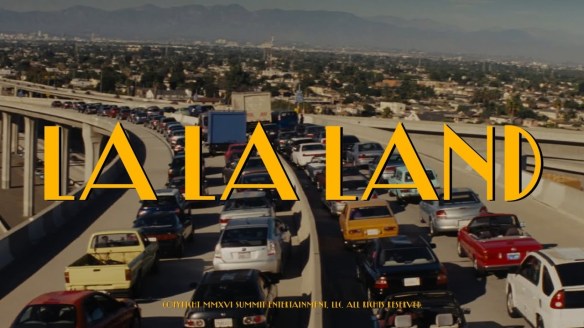
The opening of ‘La La Land’ can been viewed on a passive level to seem absurdly happy with the upbeat diegetic music, the bright colours, and synchronised dancing. However, an active spectator would see beyond this appearance, and find the true meaning of the scene. The somewhat perfect aspects of the scene contrast the harsh reality of making it in Hollywood, therefore being a representation of LA and what it’s really like. For example, the scene is edited to appear as though it’s taken in one shot, which would seem perfect and dreamlike. However, the cuts are actually hidden in whip pans suggesting that everything is not as perfect as it all seems on the surface. Plus, as they all sing on the runway, the traffic jam can be interpreted by an active spectator to be a visual metaphor for what it’s like trying to make it in LA, it’s difficult and there’s not enough space for everyone. Moreover, the diegetic song may sound upbeat and happy, but the lyrics all suggest a more negative side to the situation including what they’ve given up on to try and make it. Meanwhile, there is a synchronised dance number (an element of the musical genre) again suggesting perfection which contrasts to the reality which they express in their song. In terms of responses, I think the preferred reading of this scene is to understand the true nature of making it in LA, and to consider the upbeat music, perfect looking cinematography and the use of bight primary colours as somewhat ironic. However, the primary colours do also give to the scene in other ways because of their connotations. For example, the use of red showing passion like the woman’s dress.
However, the opening scene of ‘La La Land’ also has passive spectatorship in terms of the film exploring the old and new, specifically old and new film. The opening shot is in black and white which is reminiscent of classical Hollywood, it then becomes colourful being suggestive of the modern film industry. There’s also an accidental Marilyn Monroe reference, which they decided to keep in because of said reference, where a woman’s dress blows up like Marilyn Monroe’s did in the film ‘The Seven Year Itch’, which is one of the most iconic bits of cinema ever and so using this moment was a perfect way for the film to continue exploring the binary opposition of the old and new, as well as traditionalism and progress. An active spectatorship may be required to explore the ideas presented regarding these binary oppositions and consider how the film is exploring the conflict and compromise in creating new art in terms of the old and the new. For example, the Cinemascape writing cannot be fully seen until the twin wipe and in the process it becomes more colourful, this editing and mise en scene is suggestive of the old new being co-existent, but also how there’s conflict as they can’t both exists at the same time without compromise. However, the theme of individuality suggests the importance of individuality in creating art and it not just being about traditionalism and/or progress. The different genres of diegetic music, and the performances of different dancing shows this individuality between them, and how it’s important, as well as being a good representation of LA.
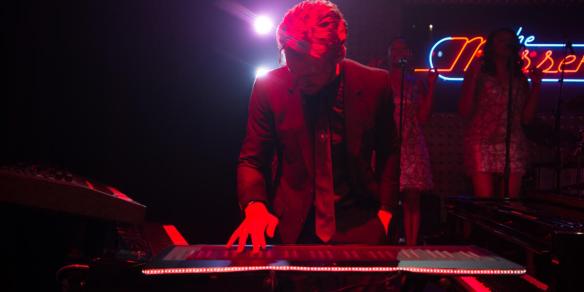
The preferred response to the Messengers scene is to understand how although Sebastian is playing for a big and appreciative crowd, it’s not his dream. A passive spectatorship can see this in Mia’s performance, and as a spectator would align with her. Her shocked face paired with the harsh blue lighting with connotations of coldness rather than the original yellow lighting, all suggest that she is empathetic but also disappointed that Sebastian is dedicating so much time to a career that isn’t his passion. Sebastian’s performance can also be interpreted by a passive spectator that he isn’t where her wants to be or should be. Whereas in the restaurant he played passionately now he plays with one hand in his pocket. It makes sense to refer to the restaurant scene, as the opening of the Messengers performance has Sebastian under spotlight which is reminiscent of the moment on the restaurant where it identified how engrossed he was in his art. Now, the screen is flooded with bright and colourful in your face lights, a visual representation that this isn’t his dream, and he notices how Mia is lost in the crowd. Passive spectators can also pick up on this due to the commercial and over the top performance such as the ridiculous dancers, the very colourful and bright lights, and the synth. The synths diegetic noise is painful to listen to, again suggesting that this isn’t a good place to be especially for Sebastian.
However, the Messenger’s scene requires an active watch from the spectator as well in terms of the representation of women. The film has been criticised for Mia being displayed as the spectator and Sebastian as the performer. A passive spectator may feel this way, but an active viewer would feel differently and get the preferred reading rather than the oppositional. Not only does Mia perform plenty, but she never passively spectates art. She notices the jazz music in the restaurant which requires attentiveness and knowledge, and in this scene her emotions are clear. Mia doesn’t clap along like the rest of the crowd she is independent and has her own opinion which she is quick to tell Sebastian without hesitation. Plus, when Sebastian doesn’t keep the relationship equally balanced by coming to her play, she ends the relationship. Furthermore, Mia represents progress and the new in the binary opposition of the old and new (traditionalism and progress), as she creates new art like her one woman show and Sebastian represents the traditionalism/old, he rewinds his tapes and wants to stick with classic jazz. This could be why Mia is seen watching him more than he’s seen spectating her because progress tends to be inspired by the old while keeping individual, whereas the old is just individual, this is an active viewing of the scene and probably the preferred reading or maybe a compromised reading of the scene/binary oppositions that run through the film.
Cinematography:
Mise en Scene
Performance
Editing
Sound
Genre
Messages
Spectatorship
Ideology
Cinematography:
Mise en Scene
Performance:
Editing:
Sound:
Genre
Messages
Themes
Spectatorship
Ideology
 Georgia Newman Film Studies