
 I used this website: https://variety.com/2004/film/awards/house-of-flying-daggers-2-1200533324/
“Two police captains, Leo (Hong Kong superstar Andy Lau) and Jin (Japanese-Taiwanese hunk Takeshi Kaneshiro), have been assigned to pry out the leader of the Flying Daggers, the most prominent of the anti-government rebel groups. Acting on a tip, Jin goes undercover to Peony Pavilion, a house of pleasure where a suspect is meant to be working.”
“This is classic martial arts stuff, as protagonists size up each other at an early stage, but Zhang stages the confrontation in a much more aestheticized way — through music, dance, color and design — than is usual. Though Mei proves his match even when he tries a final trick with the beans, Leo bests her in a subsequent encounter, through sensory overload.”
“Zhang has described the picture as “not an ordinary martial arts film, but a love story inserted into an action movie.” (In Japan, the film is to released under the English title “Lovers.”) That will broaden its appeal to distaff audiences, especially given Lau and Kaneshiro’s large following in Asia. But for a director who’s shown he’s more than capable of tugging the heartstrings (“The Road Home,” “Not One Less,” “Happy Times”) “Daggers” never really engages at an emotional level.”
“Like “Hero,” the pic has a basic hardness and rigor that marks it as northern rather than southern Chinese in flavor, however much the colorful lensing by Zhao Xiaoding (“Spring Subway,” plus an assistant d.p. to Christopher Doyle on “Hero”) and the lyrical score by onetime Japanese rock musician Shigeru Umebayashi (“In the Mood for Love”) tries to convince otherwise. Dialogue between the characters is also functional rather than inspired.”
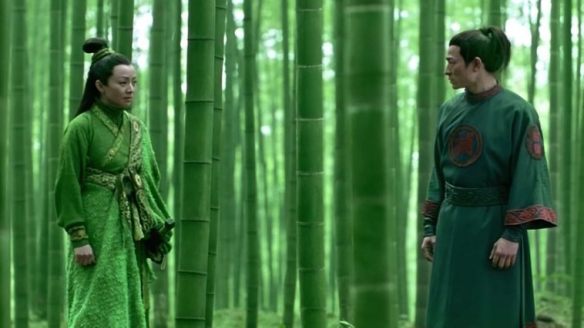
“The action set pieces really are the core of “Daggers,” and these hit the mark with eye-popping accuracy and sonic elan. From Mei’s musical gymnastics in the Echo Game, to a balletic bamboo-forest fight that tops that in “Crouching Tiger” and equals the classic sequence in King Hu’s “A Touch of Zen,” to the heroes’ final mano a mano in the snow, Hong Kong action maestro (Tony) Ching Siu-tung pushes the envelope in the combination of wire-fu and CGI, to much more gutsy and realistic effect than in “Hero.””
“In a first for a swordplay movie, a sizable chunk of the pic was shot in a pine forest near Lviv, in Ukraine, whose soft pastels and New England-like fall colors contrast memorably with the green-suffused tones of the bamboo forest, lensed in Yongchuan, southwest China. Studio interiors, in Beijing, are smaller in scale than in “Hero,” with only one standout, the ornately colored, circular Peony Pavilion set. Other credits are top drawer, especially costumes by Emi Wada (another “Hero” returnee), whose use of fabrics and leather has an almost tactile flavor.”
“For the record, the Chinese title literally means “Ambushes From Ten Sides,” title of a classic pipa virtuoso solo, which describes a battle between two ancient warlords. Here, it reflects the continual skirmishing through which the two lovers travel — an action journey that’s the real heart of the movie.”
 Georgia Newman Film Studies